The Politics of Weapons Inspections: Assessing Wmd Monitoring and Verification Regimes by Nathan E. Busch & Joseph F. Pilat
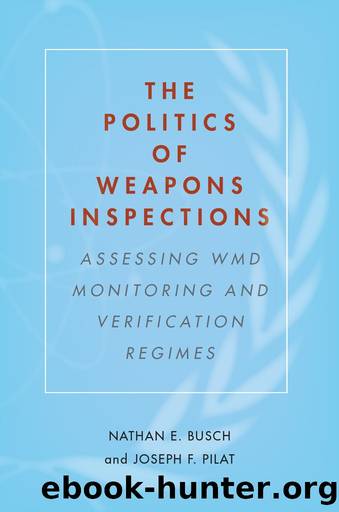
Author:Nathan E. Busch & Joseph F. Pilat [Busch, Nathan E. & Pilat, Joseph F.]
Language: eng
Format: epub
Tags: Political Science, Security (National & International)
ISBN: 9781503601628
Google: HMi9DQAAQBAJ
Goodreads: 35198621
Publisher: Stanford Security Studies
Published: 2017-03-21T00:00:00+00:00
Conclusion: Strengthening Monitoring and Verification Regimes
As the case studies considered above suggest, the inherent challenges of verification, the decisions that are made on what to verify, and difficulties within existing mechanisms for verification all suggest that we are entering a new realm of greater ambiguity. This ambiguity will be amplified by latency that derives from rolled back weapon programs and dual-use activities involving weapons of mass destruction (WMD). Moreover, while ambiguity can be reduced, it cannot be eliminated, and its reduction depends greatly on understanding both the strengths and limits of monitoring and verification technologies and extant regimes, and of taking required steps to strengthen those regimes.
Unprecedented Monitoring and Verification Challenges
In the last twenty years, monitoring and verification regimes have encountered severe and unprecedented challenges. As noted in Chapter 1 of this book, a series of revelations of clandestine nuclear-weapon programs came to light during the 1990s that challenged the entire monitoring and verification system that had been established by the Nuclear Nonproliferation Treaty (NPT) and the International Atomic Energy Agency (IAEA). These revelations included:
⢠An extensive nuclear-weapon program in Iraq discovered in the aftermath of Operation Desert Storm. This program was developed largely through clandestine facilities that were not detected and could not be detected by the existing IAEA safeguards system.
⢠South Africaâs development (and then subsequent destruction of) an operational nuclear-weapon arsenal without detection by the IAEA.
⢠North Koreaâs steps in establishing a nuclear-weapon program, developed in large part by diversion of materials from operational nuclear facilities.
At roughly the same time, concerns about the production and use of chemical and biological weapons (CBW) also grew significantly. Interest in a Chemical Weapons Convention grew in the late 1980s as a result of chemical-weapon (CW) use during the Iran-Iraq War. Moreover, after the collapse of the Soviet Union, it became clear that the Soviets had concealed a massive and extremely advanced biological-weapon program.1 Revelations about extensive clandestine CBW programs in Iraq also came to light after the 1991 Operation Desert Storm and throughout the 1990s as the UN Special Commission (UNSCOM) attempted to verify Iraqi disarmament. And, finally, there were growing concerns about emerging CBW in such countries as Syria, Libya, Iran, Egypt, North Korea, and even such nuclear-weapon powers as China. These chemical- and especially the biological-weapon programs were often viewed as the âpoor manâs nukesââalthough they most likely could not provide the same destructive power as nuclear weapons, they were less expensive and easier to produce, and could potentially be delivered quite readily via missiles and bombers but also by more unconventional methods such as crop dusters or by terrorists.
As a result, the international community worked to create new treaties and verification mechanismsâand to strengthen existing onesâto address these emerging WMD threats. Negotiations on the Chemical Weapons Convention (CWC) were completed and the treaty was opened for signature in 1993.2 There were also efforts to strengthen the verification mechanisms of the Biological Weapons Convention. In September 1994, the member states of the BWC established the Ad Hoc Group, which began exploring the prospect of onsite inspections to monitor compliance.
Download
This site does not store any files on its server. We only index and link to content provided by other sites. Please contact the content providers to delete copyright contents if any and email us, we'll remove relevant links or contents immediately.
| Arms Control | Diplomacy |
| Security | Trades & Tariffs |
| Treaties | African |
| Asian | Australian & Oceanian |
| Canadian | Caribbean & Latin American |
| European | Middle Eastern |
| Russian & Former Soviet Union |
The Secret History by Donna Tartt(19086)
The Social Justice Warrior Handbook by Lisa De Pasquale(12190)
Thirteen Reasons Why by Jay Asher(8909)
This Is How You Lose Her by Junot Diaz(6886)
Weapons of Math Destruction by Cathy O'Neil(6279)
Zero to One by Peter Thiel(5801)
Beartown by Fredrik Backman(5754)
The Myth of the Strong Leader by Archie Brown(5507)
The Fire Next Time by James Baldwin(5444)
How Democracies Die by Steven Levitsky & Daniel Ziblatt(5218)
Promise Me, Dad by Joe Biden(5153)
Stone's Rules by Roger Stone(5087)
A Higher Loyalty: Truth, Lies, and Leadership by James Comey(4962)
100 Deadly Skills by Clint Emerson(4925)
Rise and Kill First by Ronen Bergman(4788)
Secrecy World by Jake Bernstein(4753)
The David Icke Guide to the Global Conspiracy (and how to end it) by David Icke(4717)
The Farm by Tom Rob Smith(4507)
The Doomsday Machine by Daniel Ellsberg(4490)
